

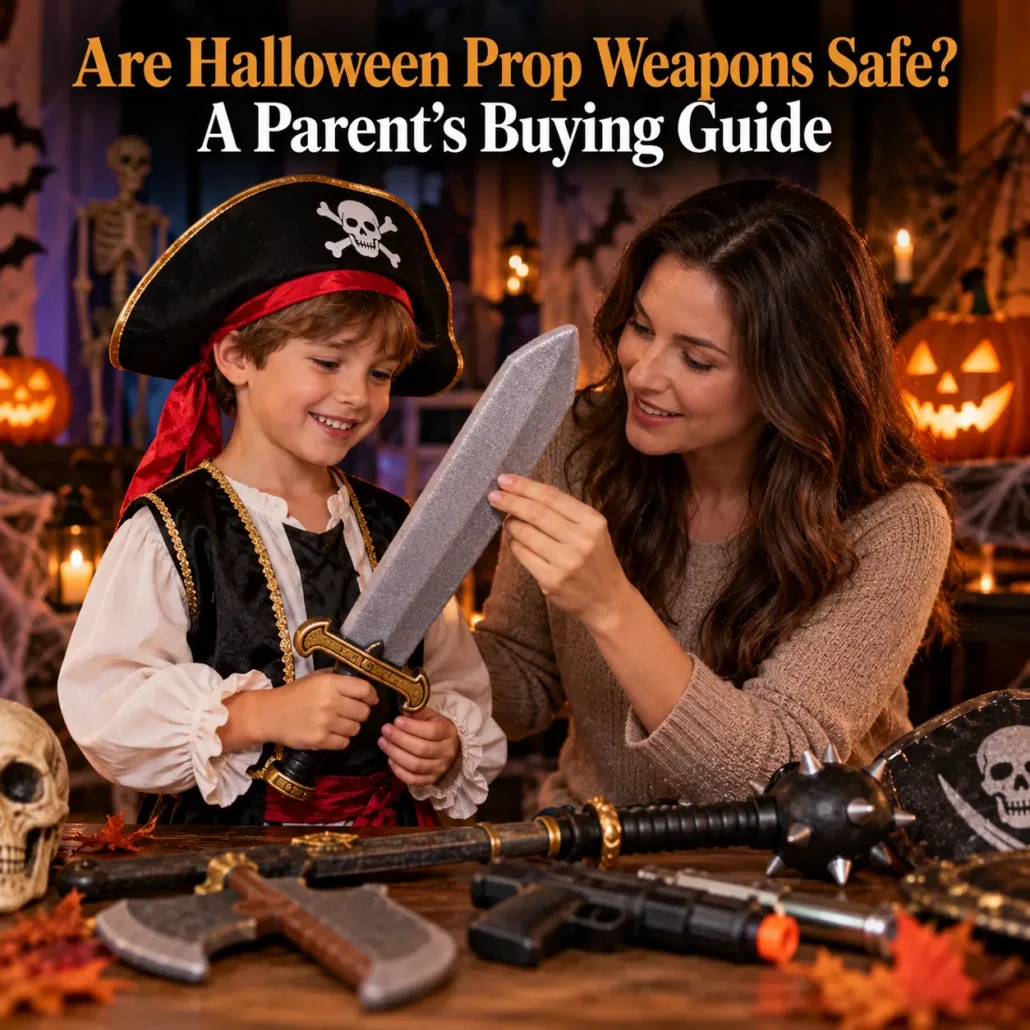
Are Halloween Prop Weapons Safe? A Parent’s Buying Guide
Your child has picked the costume. The cape is ready. The mask is packed. Then comes the request: “Can I have a sword with it?”
Halloween prop weapons can complete costumes for superheroes, pirates, fantasy characters, and historical themes. However, parents may reasonably ask, are costume prop weapons safe for kids?
The answer depends on the specific prop and how it will be used. A soft foam sword presents different risks than a rigid plastic one. A lightweight wand is not the same as a long staff, and a decorative toy differs from a prop that launches a projectile.
Good Halloween prop weapon safety begins before the costume reaches the checkout counter. Parents should evaluate the material, weight, length, construction, intended use, age recommendation, and the child’s ability to follow basic safety rules.
It is also important to consider where the costume will be worn, since schools, community events, and public venues may have their own restrictions on prop weapons.
What Counts as a Halloween Prop Weapon?
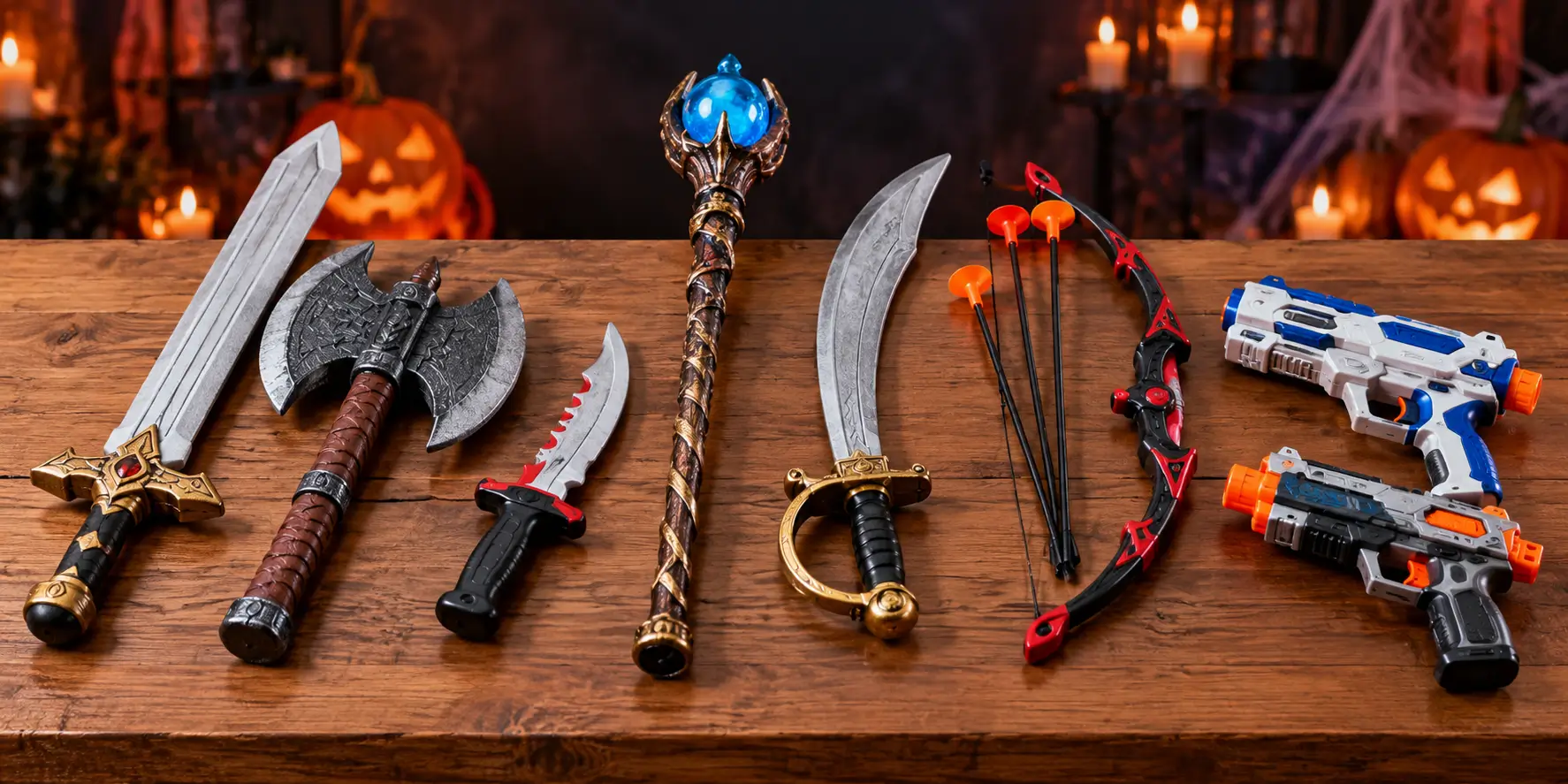
A Halloween prop weapon is a costume accessory designed to resemble a weapon or weapon-like object. It is generally intended to complete a character rather than function as a real weapon.
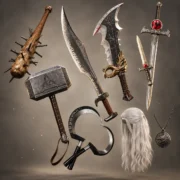
Common examples include:
- Foam swords.
- Costume axes.
- Plastic knives.
- Fantasy staff.
- Pirate swords.
- Toy bows and arrows.
- Superhero weapon-style accessories.
- Toy gun-style costume accessories.
The important difference is not just what the prop looks like. Construction matters too. A soft accessory designed only for appearance presents different concerns from a rigid object with a pointed end. Similarly, a prop that launches an object requires more consideration than one that remains entirely decorative.
Parents should assess each product individually rather than assume every item in the same category presents the same level of risk.
Are Some Halloween Prop Weapons Safer Than Others?
Yes. Soft, lightweight, age-appropriate designs are generally easier for children to handle safely.
| Prop Type | What Parents Should Check | General Concern |
|---|---|---|
| Foam sword | Softness, length, overall construction | Lower concern when age-appropriate |
| Soft axe | Handle and head attachment | Check construction |
| Rigid plastic sword | Point and edges | Greater injury potential |
| Toy bow | Whether it launches projectiles | Depends on design |
| Toy gun | Realistic appearance | Public-setting concerns |
| Long staff | Length and weight | Striking or tripping risk |
| Small detachable prop | Loose or small parts | Choking concern for young children |
This comparison is a starting point, not a guarantee of safety. Even a soft accessory can become a problem if a child swings it at another person or cannot control it properly.
What Makes a Halloween Prop Weapon a Better Choice for a Child?
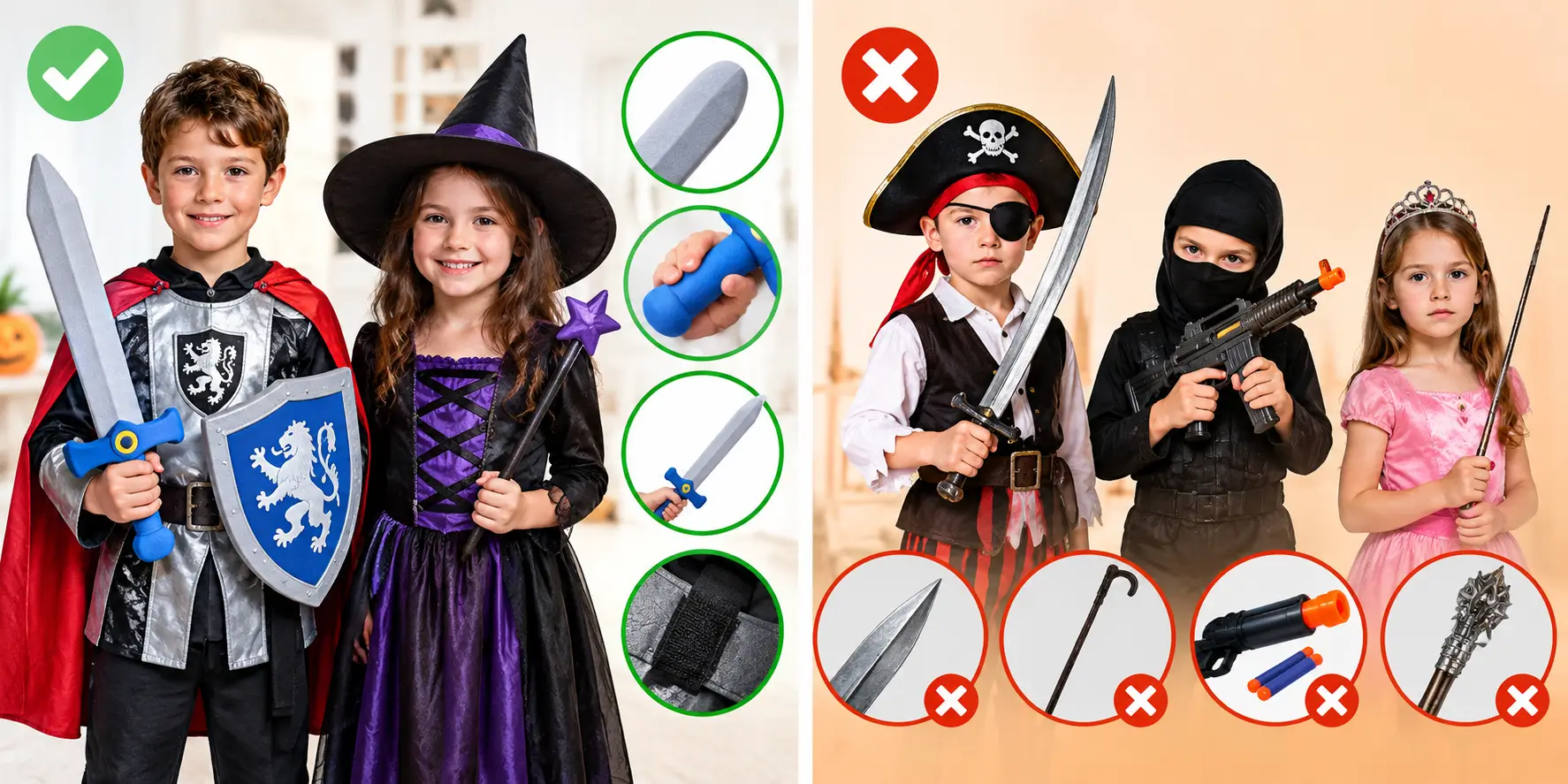
Once you have narrowed down the type of prop, look at its physical design. This is where Halloween prop weapon safety becomes a practical buying decision.
1. Soft Construction
Soft or flexible materials are generally a better choice for weapon-style costume accessories. Foam prop weapons can reduce the risk associated with rigid edges and hard surfaces.
However, “foam” does not automatically mean safe. Parents should inspect the complete construction, including handles, decorative pieces, and any internal components.
2. Rounded Edges and Tips
Avoid accessories with unnecessary sharp edges or pointed ends. A decorative sword does not need a sharp-looking tip to complete a costume.
3. Lightweight Design
A prop should not be difficult for a child to carry. If it is too heavy, the child may struggle to control it or become tired during an event. A lighter design is also easier to put away when the child no longer needs it.
4. Appropriate Length
Long accessories can be difficult to manage in crowded spaces. They can interfere with walking, doorways, stairs, or other children.
The American Academy of Pediatrics recommends avoiding sharp or long swords, canes, and sticks as costume accessories for children.
5. Securely Attached Parts
Check whether the handle, decorative pieces, straps, and other components are firmly attached.
A prop can become less suitable if pieces are loose, broken, or easily detached during normal use.
Which Halloween Prop Weapons Should Parents Think Twice About?
Some designs deserve extra attention before you buy them. Consider how the prop is made, how your child will use it, and where they plan to wear it.
1. Hard, Sharp, or Pointed Props
Rigid accessories with hard edges or pointed ends have greater potential to cause injury during accidental contact. If a softer alternative creates the same costume effect, it may be the better choice.
2. Long Swords, Canes, and Sticks
Length matters because children move through crowded spaces differently from adults. A long accessory can hit someone accidentally, catch on objects, or make walking more difficult.
3. Projectile-Based Props
Parents should be more cautious with bows, dart-style toys, or any accessory designed to launch an object. The concern is no longer limited to the prop itself. A launched object can travel toward another child or cause an impact injury.
4. Highly Realistic Gun-Style Props
Realistic-looking gun-style accessories create a separate concern in public settings. Even when an item is intended as a costume accessory, other people may not immediately recognize it as a toy.
For children’s public Halloween activities, a clearly non-weapon alternative is the safer choice. Parents should also check the rules of the specific event or location.
5. Modified or Homemade Hard Props
Making something at home does not automatically make it safer. Rigid materials, exposed hardware, sharp edges, or poorly attached parts can create additional risks.
If a homemade accessory is difficult to inspect or control, consider a simpler costume accessory instead.
How Can Parents Inspect a Halloween Prop Before Buying It?
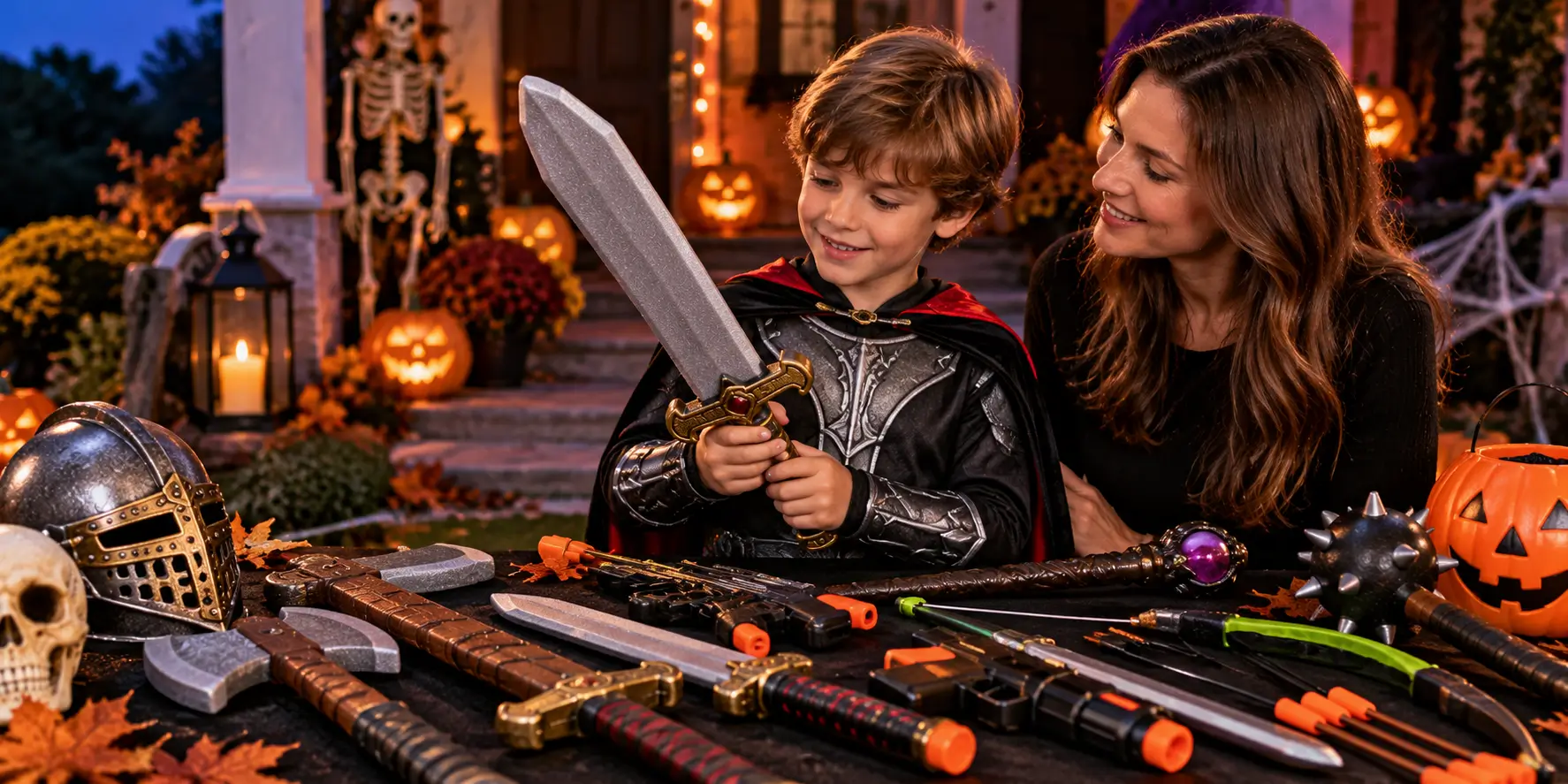
A quick inspection can tell you a lot. You do not need a complicated test. Use this 60-second store check before buying.
- Press: If the design is supposed to be soft, check whether the material actually has some flexibility.
- Check the Edges: Look for sharp edges, pointed tips, rough seams, or exposed parts.
- Lift It: Hold the prop and consider whether your child could comfortably carry it for the length of the event.
- Check the Connections: Look at handles, decorative attachments, straps, and other components. They should not appear loose or poorly secured.
- Read the Label: Check the recommended age and any warnings provided by the manufacturer.
- Think About the Event: A prop that might work for a supervised costume party may not be appropriate for trick-or-treating, school, or a crowded public event.
This quick inspection is one of the simplest ways to put Halloween prop weapon safety into practice before making a purchase.
Is the Prop Actually Right for Your Child?
The product itself is only part of the decision. Your child’s age, behavior, and ability to follow instructions matter too.
1. Consider Your Child’s Age
A prop that works for an older child may not be appropriate for a toddler. Younger children may have less control over objects and may not understand why swinging or pointing a costume accessory is unsafe.
Always follow the manufacturer’s age guidance.
2. Consider Your Child’s Behavior
Ask yourself:
- Does my child tend to swing objects around?
- Can they follow a “no hitting” rule?
- Can they carry the prop without running?
- Will they listen when asked to put it away?
- Can they handle the accessory without becoming distracted?
If the answer to several of these questions is no, leaving the prop out may be the better choice.
3. Consider the Costume
Finally, ask whether the prop is actually necessary. A superhero can have a shield and cape. A pirate can wear a hat and eye patch. A fantasy character can carry a wand or wear a dramatic cloak.
If removing the weapon-style accessory does not affect the costume much, choosing a different accessory may make the entire outfit easier to manage.
Is a Halloween Prop Weapon Safe for Trick-or-Treating?
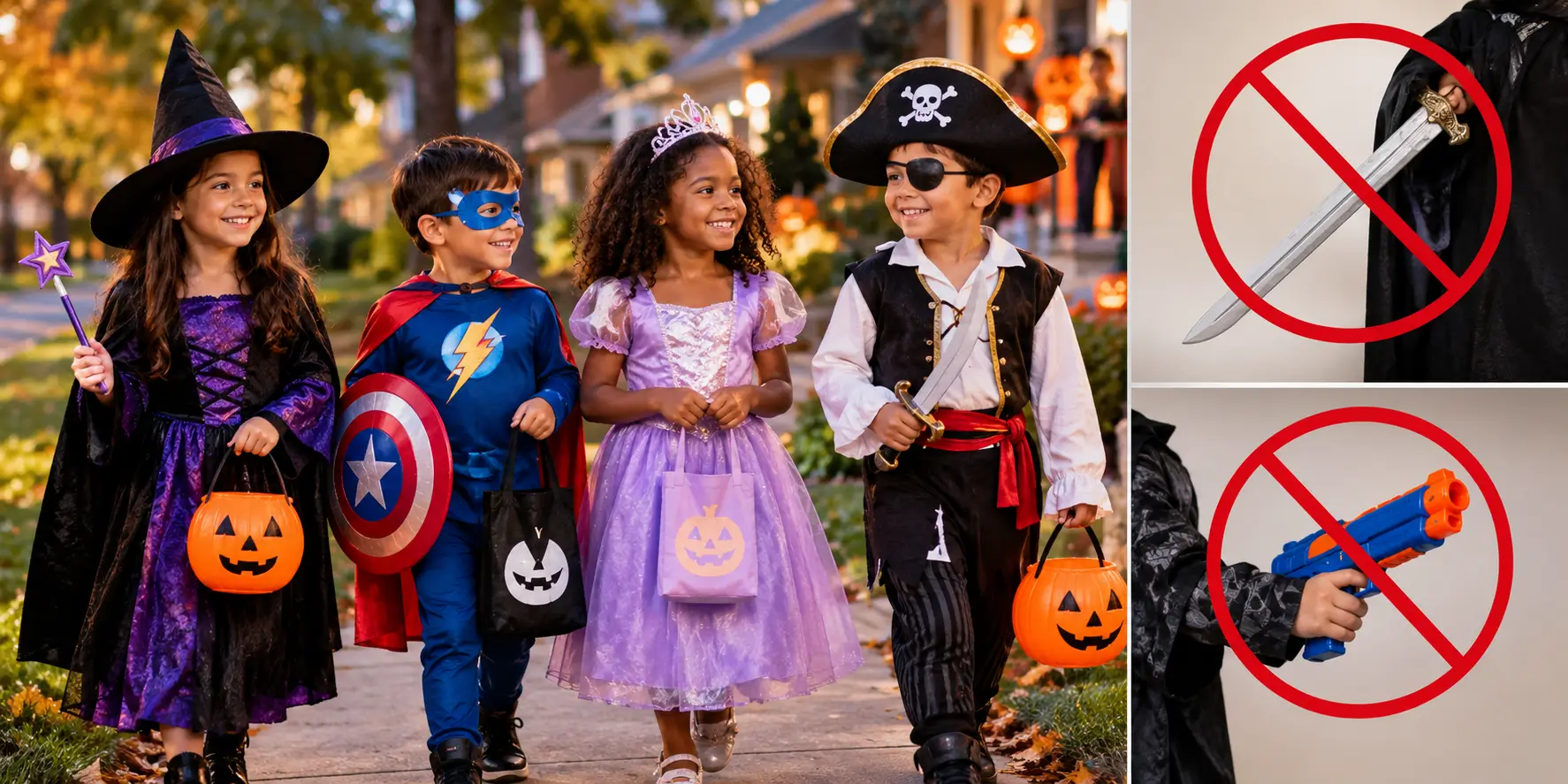
Trick-or-treating creates a different environment from a party at home.
Children are walking outdoors, often after dark. Sidewalks can be crowded. Other children may be wearing large costumes or carrying their own accessories. Running, stairs, uneven surfaces, and limited visibility can make long props harder to manage.
For this reason, Halloween prop weapon safety should include the environment where the accessory will be used.
Better Choices for Trick-or-Treating
Consider accessories that are:
- Soft and lightweight.
- Easy to carry.
- Short enough not to interfere with walking.
- Unlikely to catch on to other costumes.
- Clearly decorative rather than realistic.
A shield, wand, cape, themed bag, mask, or gloves can often create the same character effect without adding a long weapon-style accessory.
The CPSC also recommends well-fitting costumes that do not drag, sturdy shoes, and good visibility while trick-or-treating.
Can Your Child Take a Weapon Prop to School?
Do not assume that a costume accessory allowed at a Halloween party will also be allowed at school.
Schools, daycare centers, camps, community programs, and other children’s events may have their own rules about weapon-style costume accessories. Some may prohibit them completely.
Check the rules before sending the prop with your child. If the policy is unclear, contact the school or event organizer.
When in doubt, choose a non-weapon accessory. A cape, hat, mask, gloves, themed bag, or other costume detail can preserve the character without creating a policy issue.
What About Halloween Prop Guns?
Gun-style costume accessories require extra caution, especially in public. Avoid realistic-looking props for trick-or-treating, community events, and other public gatherings. Choose clearly fictional designs instead, and check local laws and event rules before use.
Halloween prop weapon safety involves more than whether an item is technically a toy. Parents should also consider how it may be perceived and used.
How Should Children Handle Halloween Prop Weapons?
Even a soft costume accessory needs clear rules. Explain that it is for completing the costume, not for hitting, chasing, or fighting.
Before Halloween, explain these five simple rules:
- No swinging.
- No pointing at people.
- No hitting or fighting.
- No running with long accessories.
- Put the prop away when it is not needed.
These rules are easier for children to remember when they are explained before the event rather than after a problem occurs.
Younger children may also need closer supervision, particularly when costumes, crowds, and exciting activities make it harder for them to follow instructions.
What Are Safer Alternatives to Halloween Weapon Props?
A costume can still look complete without a weapon-style accessory. A few well-chosen details can make the character instantly recognizable while keeping the outfit easier to wear and manage.
| Costume Theme | Safer Alternatives |
|---|---|
| Superhero | Shield, cape, mask, gloves |
| Fantasy | Wand, crown, cape, magical accessories |
| Pirate | Hat, eye patch, treasure bag, jewelry |
| Medieval | Shield, cloak, heraldic accessories |
| Horror | Mask, makeup, prosthetics, wig |
These safe Halloween costume props can add character without requiring a sword, knife, axe, or similar accessory.
They can also make the costume easier to wear throughout a party or while walking around the neighborhood.
Halloween Prop Weapon Safety Checklist
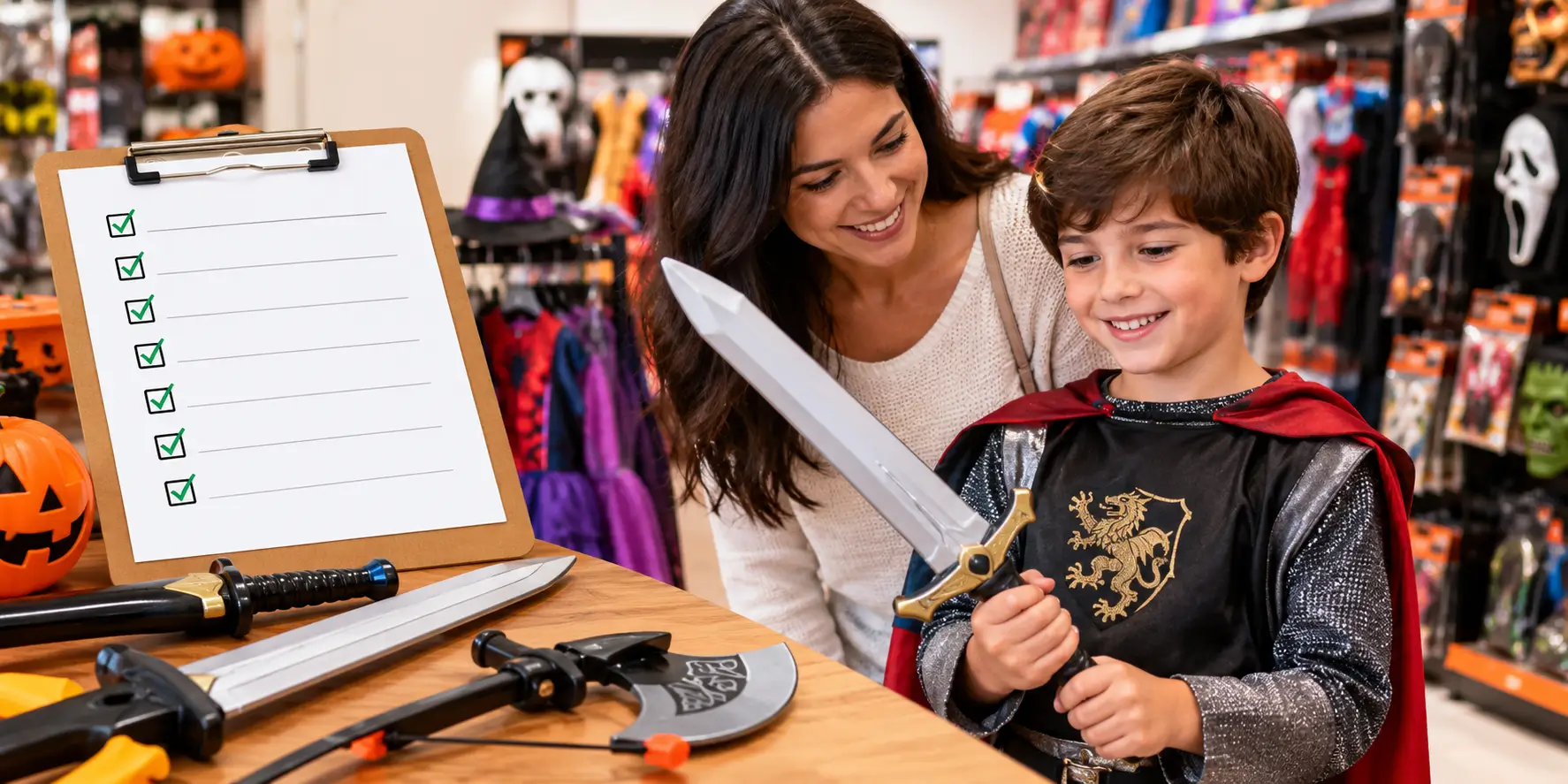
Use this quick checklist before your child carries any weapon-style costume accessory:
- Is it age-appropriate?
- Is the material soft or flexible where appropriate?
- Does it have rounded edges?
- Does it have a pointed tip?
- Is it lightweight enough?
- Are all parts secure?
- Does it launch anything?
- Can the child carry it without tripping?
- Is it allowed at the event?
- Can the child follow the handling rules?
A “no” answer does not always mean the prop is automatically dangerous. It means the item deserves another look before you decide to buy or use it.
Where Can Parents Shop for Halloween Costumes and Accessories?
Shopping at a dedicated Halloween store lets parents inspect costumes and accessories in person.
At Kreepy Halloween, shoppers can find children’s and family costumes, wigs, masks, makeup, capes, hats, gloves, and other accessories. Check each item’s size, weight, construction, and suitability before buying, and consider replacing a weapon-style prop with a safer costume detail if needed.
Conclusion
The safest choice depends on the prop’s design, your child’s age and behavior, and where it will be used. Choose soft, flexible, lightweight accessories, and avoid rigid, pointed, or realistic designs.
Consider trick-or-treating conditions, school rules, and event policies before making a decision. If a weapon-style prop creates concerns, leave it out, your child’s costume can still look great without one.
For more costume ideas and safe Halloween costume props, visit Kreepy Halloween for costumes, wigs, masks, makeup, capes, hats, gloves, and other accessories.
FAQs
1. Are foam prop weapons safe for children to carry?
Foam prop weapons are generally a better option than rigid props, but parents should still check the design, age recommendation, weight, length, and construction.
2. What age is appropriate for costume prop weapons?
There is no single suitable age for every prop. Always follow the manufacturer’s age guidance and consider your child’s coordination, behavior, and ability to follow instructions.
3. How do you tell a safe prop from a realistic-looking one?
A safer costume prop is clearly decorative, lightweight, and designed with soft or flexible materials. Realistic-looking props can create additional concerns, particularly in public settings.
4. Are plastic or foam props better for young kids?
Foam props are generally preferable for young children because they are softer and more flexible. However, parents should still inspect construction and follow recommended age limits.
5. What should you avoid when choosing costume weapon props?
Avoid sharp or pointed parts, rigid designs, excessive weight, long accessories, loose components, projectile features, and realistic-looking weapon designs that may cause concerns.
6. How do you supervise kids wearing costume props at events?
Set clear rules before the event, prevent swinging or hitting, watch younger children closely, and remove the prop if your child cannot control it properly.
7. What materials are prop weapons typically made from?
Halloween prop weapons may use foam, soft plastic, rigid plastic, rubber, fabric, wood, or mixed materials. Construction and flexibility can vary significantly between products.
8. Are light-up or sound prop weapons safe for nighttime use?
Light-up features can improve visibility, while sounds may attract attention. Check battery compartments, volume, construction, and event rules before allowing children to use them.
9. What should you check before buying a prop weapon accessory?
Check the recommended age, material, weight, length, edges, points, attachments, moving parts, projectiles, warning labels, and whether the accessory suits your child’s planned activity.
10. How do you store costume prop weapons safely at home?
Store costume props in a dry, organized location away from young children. Keep sharp-looking or rigid accessories secured, and inspect items for damage before reuse.




Leave a Reply
Want to join the discussion?Feel free to contribute!