Fun Halloween Trivia and Facts Everyone Should Know Before October 31st
Halloween feels like a modern celebration of costumes, candy, pumpkins, haunted houses, and parties. But many of the traditions we recognize today have much older—and sometimes very different—origins.
The story of Halloween stretches back more than 2,000 years. Its modern form developed gradually through a mixture of ancient seasonal traditions, Christian observances, European folklore, immigration, and American popular culture.
That means there is much more to Halloween than dressing up and asking for candy.
Why were people once carving turnips instead of pumpkins? When did children actually start saying “trick or treat”? How did a Celtic seasonal festival become one of America’s biggest celebrations?
Let’s look at the history behind Halloween and uncover some fun facts about Halloween along the way.
Halloween History at a Glance
Before getting into the individual traditions, it helps to see how Halloween developed over time.
| Period | Halloween milestone |
|---|---|
| More than 2,000 years ago | Celtic communities in parts of Ireland and Britain observed Samhain, a seasonal festival associated with the transition into winter. |
| 8th century | November 1 became associated with the Christian feast of All Saints in Rome under Pope Gregory III. |
| 835 | The November 1 date for All Saints’ Day was adopted more broadly in the Western Christian calendar under Pope Gregory IV. |
| Medieval period | The evening before All Saints’ Day became known as All Hallows’ Eve, eventually giving us the word Halloween. |
| 19th century | Irish and Scottish immigrants helped bring Halloween customs to North America. |
| 1920s | Organized Halloween celebrations and costumed door-to-door visits became increasingly visible in the United States. |
| After World War II | Trick-or-treating became increasingly popular across the United States. |
| Today | Halloween has become a major secular celebration centered on costumes, candy, decorations, entertainment, and community events. |
The important thing to remember is that Halloween did not appear fully formed from one ancient festival. Its traditions developed and changed over many centuries.
Where Did Halloween Actually Come From?
The earliest influence commonly connected with Halloween is Samhain, a seasonal festival observed by Celtic communities in parts of Ireland and Britain more than 2,000 years ago.
Samhain marked an important point in the agricultural year—the transition from the lighter half of the year toward winter. Historical accounts and later folklore associate the festival with bonfires, gatherings, and beliefs about supernatural beings.
However, it would be misleading to say that modern Halloween is simply “the ancient Celtic festival of Samhain.”
Halloween developed much later through several cultural influences.
A major change came with the Christian calendar. November 1 became associated with All Saints’ Day, and the evening before it became known as All Hallows’ Eve. Over time, the name was shortened to Halloween.
The result was a holiday with layers of history rather than a single point of origin.
A Timeline of Halloween: From Samhain to Trick-or-Treating
More Than 2,000 Years Ago: Samhain
Long before Halloween existed as we know it, Celtic communities observed seasonal festivals connected with the agricultural year.
Samhain was traditionally associated with the transition from summer to winter. It also developed supernatural associations, with folklore describing this period as a time when the boundary between the human world and the supernatural became less certain.
These beliefs help explain why later Halloween traditions became so strongly associated with ghosts, spirits, witches, and other supernatural imagery.
8th–9th Century: All Saints’ Day Moves Into the Story
Halloween’s name and date are also connected with Christian traditions.
In the 8th century, Pope Gregory III established a November 1 observance honoring saints at Rome’s St. Peter’s Basilica. By 835, November 1 had become the date for All Saints’ Day throughout the Western Christian world under Pope Gregory IV.
The evening before All Saints’ Day became known as All Hallows’ Eve.
The word “hallow” means a holy person or saint, so “All Hallows’ Eve” literally refers to the evening before All Saints’ Day.
Over time, “All Hallows’ Eve” became “Hallowe’en” and eventually Halloween.
Medieval Europe: Customs Begin to Mix
During the medieval period, Halloween-related customs continued to develop.
People marked Allhallowtide—the period surrounding All Saints’ Day and All Souls’ Day—with religious observances, food, community gatherings, and folk customs.
Some traditions involved going from house to house. Others involved prayers for the dead or receiving food.
These customs would eventually contribute to later Halloween practices, although modern trick-or-treating did not exist in its current form during the medieval period.
19th Century: Halloween Arrives in North America
Halloween changed significantly after Irish and Scottish immigrants brought their traditions to North America during the 19th century.
American communities began adapting European customs to local traditions.
Instead of remaining primarily connected with religious observances or seasonal folklore, Halloween increasingly became a community celebration involving parties, games, costumes, pranks, and social gatherings.
This was the beginning of the Halloween that looks much more familiar today.
1920s: Trick-or-Treating Begins Taking Shape
By the 1920s, costumed Halloween activities and door-to-door visits were being documented in American communities.
The Massachusetts Commonwealth Museum notes that trick-or-treaters were already being seen in Wellesley during the 1920s.
The modern custom developed from older European traditions, but it was not simply transported unchanged from Europe. American communities reshaped it into the neighborhood tradition we recognize today.
After World War II: Trick-or-Treating Becomes Mainstream
The biggest transformation came after World War II.
The postwar baby boom created a huge population of children, while growing consumer culture made commercially produced costumes, decorations, and individually packaged candy easier to buy.
Trick-or-treating became a convenient way for neighborhoods to celebrate Halloween together.
By the middle of the 20th century, the tradition had become firmly established in American culture.
Why Do We Wear Halloween Costumes?
Costumes are one of the oldest-looking parts of Halloween, but their history is more complicated than simply “people dressed like ghosts.”
European Halloween and All Hallows’ Eve traditions included forms of disguise and masquerading. In some customs, people dressed in unusual clothing or disguised themselves while going from house to house.
These practices were connected to folklore, seasonal celebrations, and beliefs about supernatural beings.
Over time, the meaning of the costume changed.
Instead of dressing up primarily because of supernatural beliefs, people increasingly used Halloween costumes for entertainment and creativity.
Today, you can be a vampire, superhero, movie character, animal, historical figure—or practically anything else.
Fun fact: The modern Halloween costume has evolved from traditions of disguise into a form of self-expression and popular culture.
Why Do We Say “Trick or Treat”?
“Trick or treat” sounds like it has been around forever, but the phrase is much newer than Halloween itself.
Its roots can be connected to older European traditions such as guising and souling.
In guising, particularly associated with Scotland and Ireland, people dressed up and visited homes, sometimes performing in exchange for food or other treats.
Souling was associated with people visiting homes and receiving food in exchange for prayers for the dead.
American Halloween gradually combined elements of these traditions with local customs.
By the 1920s, American communities were documenting organized trick-or-treating and costumed door-to-door activities. The practice expanded considerably after World War II.
So the next time a child says “trick or treat,” remember: the phrase may sound simple, but the custom behind it has a surprisingly long history.
Why Do We Carve Pumpkins for Halloween?
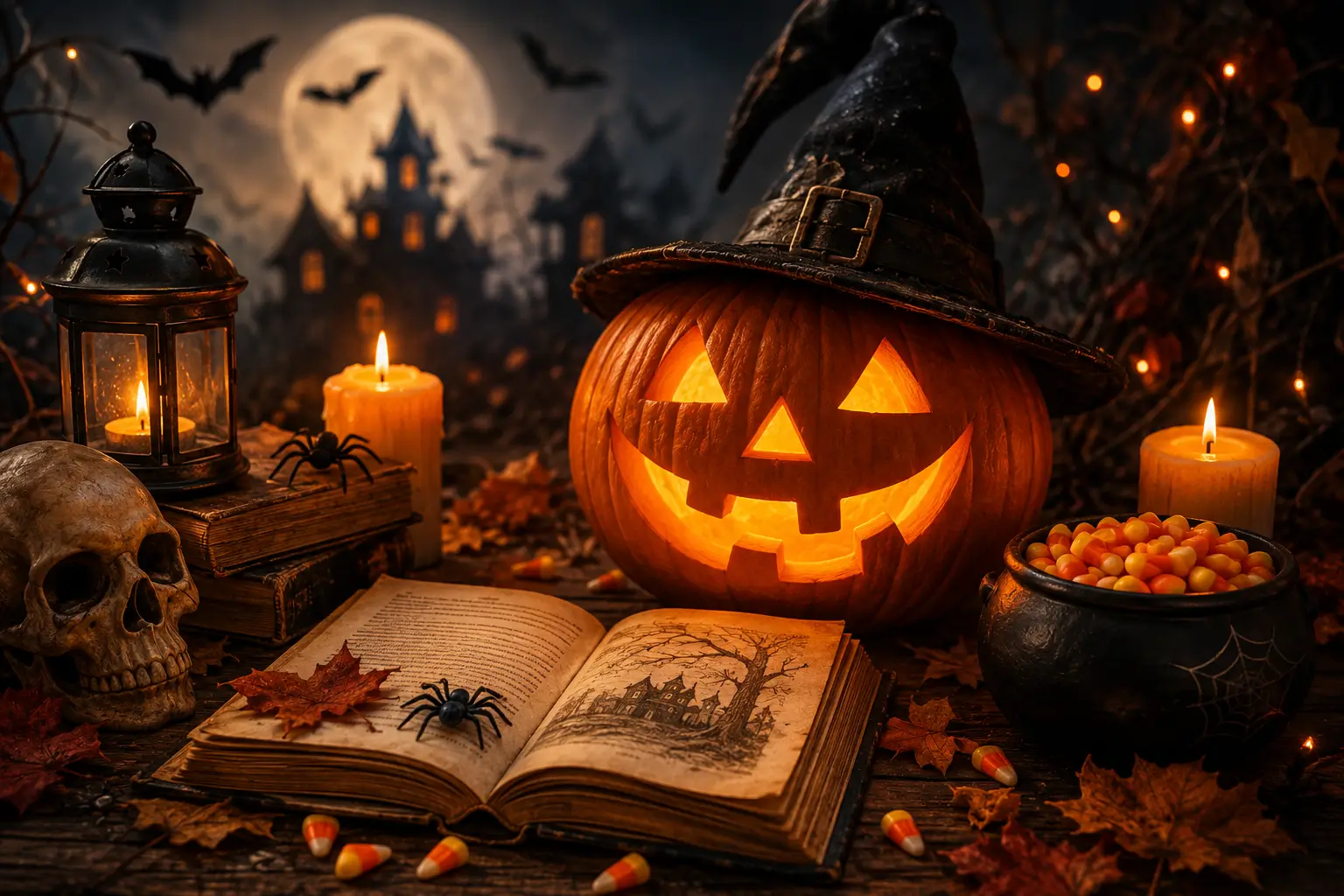
Here’s one of the most surprising Halloween facts:
The original jack-o’-lanterns were not usually made from pumpkins.
In parts of Ireland and Britain, people traditionally carved turnips and other root vegetables into lanterns.
The practice became associated with Halloween and folk traditions surrounding supernatural beings.
When Irish immigrants brought these customs to North America, they discovered something much easier to carve: the pumpkin.
Pumpkins were already native to North America and were larger and softer than many of the vegetables traditionally used in Europe.
The pumpkin eventually became the classic Halloween lantern.
So the pumpkin may be one of Halloween’s most recognizable symbols, but it wasn’t where the tradition started.
Where Did the Name “Jack-o’-Lantern” Come From?
The name jack-o’-lantern is connected with Irish folklore.
One popular story tells of a man called Stingy Jack, who supposedly tricked the Devil and was later condemned to wander with only a burning coal inside a carved vegetable to light his way.
Different versions of the story exist, and the folklore should be treated as legend rather than documented history.
What is better supported historically is the practice of carving vegetables such as turnips into lanterns in Ireland and Britain.
When the tradition crossed the Atlantic, pumpkins eventually became the preferred material.
The spooky face, the glowing candle, and the name all came together to create the jack-o’-lantern we know today.
Why Are Black and Orange Halloween Colors?
Black and orange have become the signature colors of Halloween.
Orange naturally connects the holiday with autumn, pumpkins, harvests, and changing leaves.
Black represents night, darkness, mystery, and the supernatural imagery that became associated with Halloween.
Together, the two colors create the visual identity we now see on Halloween decorations, costumes, invitations, candy packaging, and party supplies.
Unlike the origins of Samhain or All Hallows’ Eve, however, there isn’t one specific historical event that officially established black and orange as Halloween’s colors.
Their popularity developed gradually through seasonal and spooky imagery.
Why Are Bats, Black Cats, Spiders, and Owls Halloween Symbols?
Halloween has collected an entire cast of creepy creatures over the centuries.
Bats
Bats have both seasonal and supernatural associations with Halloween.
Bonfires traditionally associated with Samhain could attract insects, which in turn could attract bats. Later European folklore also connected bats with darkness and supernatural stories.
Black Cats
Black cats became associated with Halloween partly through European folklore surrounding witches and superstition.
Their nighttime activity and dark appearance made them natural additions to Halloween imagery.
However, the idea that black cats are inherently unlucky is a superstition, not a fact.
Spiders
Spiders became popular Halloween symbols because webs and spiders create an immediate association with abandoned, dark, and neglected spaces.
A spider web-covered house simply looks spooky.
Owls
Owls are nocturnal and have appeared in folklore as mysterious or ominous creatures.
Their connection with nighttime makes them a natural fit for Halloween decorations and storytelling.
How Did Halloween Become Popular in America?
Halloween’s transformation into a major American celebration happened gradually.
During the 19th century, large numbers of Irish and Scottish immigrants brought Halloween customs to North America.
American communities adapted these traditions.
By the late 19th and early 20th centuries, Halloween celebrations increasingly included parties, games, costumes, decorations, and neighborhood activities.
During the 1920s and 1930s, newspapers, magazines, schools, clubs, and community organizations helped spread organized Halloween celebrations.
After World War II, Halloween became even more commercial and family-focused.
Commercial costumes, decorations, greeting cards, and candy became increasingly common, while trick-or-treating became one of the holiday’s defining traditions.
Halloween was no longer primarily a collection of old seasonal customs.
It had become a distinctly modern American holiday.
Halloween Candy: When Did Candy Become Part of the Celebration?
Candy feels like it has always been part of Halloween, but that isn’t true.
Earlier door-to-door traditions involved a much wider range of treats, including fruit, nuts, baked goods, coins, and other foods or small gifts.
Candy became increasingly important during the 20th century, particularly as Halloween became more commercialized.
The growth of individually packaged candy made it especially convenient for families to hand out treats to large numbers of children.
A Sweet Halloween Fact: Candy Corn Is Over 100 Years Old
Candy corn dates back to the 1880s.
George Renninger of the Wunderle Candy Company is commonly credited with creating the candy, and commercial production followed in the late 19th century.
It was originally marketed as a harvest-themed candy rather than being exclusively associated with Halloween.
Over time, its yellow, orange, and white appearance became strongly connected with the fall season and eventually Halloween.
Halloween Movie and Pop Culture Trivia
Halloween hasn’t stayed frozen in history.
Movies, television, music, video games, and internet culture constantly change the way people celebrate it.
During the 20th century, horror movies helped popularize characters such as vampires, witches, monsters, ghosts, zombies, and masked killers.
Later, television and blockbuster movies turned fictional characters into popular Halloween costumes.
Today, Halloween costumes can come from almost anywhere:
- Movies and television
- Video games
- Superheroes
- Music
- Memes and internet trends
- Famous people
- Classic monsters
- Children’s characters
That’s one reason Halloween continues to evolve.
A costume that barely existed one year can become one of the most popular choices the next.
10 Surprising Halloween Facts You Probably Didn’t Know
Ready for some quick Halloween trivia?
1. Halloween is more than 2,000 years old
Its earliest commonly cited influence is Samhain, a seasonal festival associated with Celtic communities in parts of Ireland and Britain.
2. Halloween’s name comes from All Hallows’ Eve
“All Hallows’ Eve” means the evening before All Saints’ Day.
3. Pumpkins weren’t the original jack-o’-lanterns
Turnips and other root vegetables were traditionally carved in parts of Ireland and Britain before pumpkins became popular in North America.
4. Trick-or-treating is much newer than Halloween
Modern American trick-or-treating developed from older European customs and became especially widespread in the 20th century.
5. Candy wasn’t always the main Halloween treat
Fruit, nuts, baked goods, coins, and other small gifts appeared in earlier door-to-door traditions.
6. Candy corn dates to the 1880s
The candy was created in the late 19th century, decades before it became strongly associated with Halloween.
7. Anoka, Minnesota, calls itself the “Halloween Capital of the World”
Anoka has held organized Halloween celebrations since 1920 and continues to use the title today.
8. Black cats weren’t originally a Halloween invention
Their Halloween association grew from older European folklore involving superstition, witches, and nighttime imagery.
9. Halloween costumes have changed dramatically
Costumes once had stronger connections with disguise and folklore. Today, they’re largely about entertainment, creativity, and popular culture.
10. Modern Halloween is a mixture of traditions
The Halloween celebrated today reflects Celtic seasonal traditions, Christian observances, European folklore, immigrant customs, and American popular culture.
Halloween History: Fact vs. Myth
Halloween history is full of stories, but not every popular Halloween claim is historically proven.
Myth: Halloween is simply Samhain under a new name.
Reality: Samhain is an important historical influence often associated with Halloween’s early development, but modern Halloween emerged through multiple cultural and religious traditions over many centuries.
Myth: Pumpkins have always been Halloween lanterns.
Reality: Turnips and other vegetables were traditionally used for carved lanterns in parts of Ireland and Britain. Pumpkins became popular after the custom reached North America.
Myth: Trick-or-treating has existed unchanged for thousands of years.
Reality: Modern trick-or-treating is much newer. It developed from several older customs and became established in North America during the 20th century.
Myth: Black cats are bad luck.
Reality: The association between black cats and bad luck comes from folklore and superstition. It isn’t a scientific fact.
Myth: Halloween has one exact country of origin.
Reality: Halloween does not have a simple one-country origin. Its early influences are associated with Celtic traditions in parts of Ireland and Britain, while the holiday itself developed through later Christian, European, and North American traditions.
What Is the Best-Selling Halloween Candy in the US?
There isn’t one permanent answer because candy rankings change depending on the year, retailer, region, and methodology.
Reese’s Peanut Butter Cups frequently appear near the top of U.S. Halloween candy rankings, but other popular choices include Skittles, M&M’s, Snickers, and candy corn.
For that reason, it is better to treat “best-selling Halloween candy” as a current-year ranking question rather than a timeless historical fact.
What City Is the Halloween Capital of the World?
Anoka, Minnesota, is widely known by the nickname “Halloween Capital of the World.”
The city’s organized Halloween tradition dates back to 1920, when community leaders promoted Halloween celebrations and parades as a way to replace destructive Halloween pranks with organized activities.
The tradition continues today with parades, contests, and other Halloween events.
What Country Did Halloween Originate From?
There isn’t a single country that can be given as the complete birthplace of modern Halloween.
Its earliest commonly cited influences are connected with Celtic communities in parts of Ireland and Britain, particularly the seasonal festival of Samhain.
However, the Halloween we celebrate today developed much later through Christian observances, European folklore, immigration, and American cultural traditions.
So the most accurate answer is:
Halloween has multiple historical influences rather than one single country of origin.
Why Is Halloween Still So Popular?
Perhaps the most interesting thing about Halloween is how successfully it has reinvented itself.
Its history includes ancient seasonal traditions, medieval religious observances, European folklore, immigrant customs, American community celebrations, and modern entertainment.
Yet the basic idea remains surprisingly familiar:
Dress up. Tell stories. Decorate. Share treats. Have fun.
That flexibility may be one reason Halloween has survived and evolved for centuries.
From Samhain more than 2,000 years ago to neighborhood trick-or-treating in modern America, Halloween has continually changed to fit the people celebrating it.
Conclusion: The History Behind the Spookiness
Halloween is much more than pumpkins and candy.
Its history is a journey through more than two millennia of changing traditions—from ancient seasonal festivals and medieval religious observances to Irish and Scottish customs, American immigration, neighborhood celebrations, and modern pop culture.
The next time you see a carved pumpkin, hear someone say “trick or treat,” or put on a Halloween costume, you’ll know that each tradition has a story behind it.
And now you have plenty of Halloween trivia to test your friends with, too.
So before October 31 arrives, pick your favorite fact, challenge your family, and see who really knows their Halloween history.
FAQs About Halloween Facts and Trivia
What are fun facts about Halloween most people don’t know?
Halloween has roots stretching back more than 2,000 years; jack-o’-lanterns were traditionally carved from turnips and other vegetables in parts of Ireland and Britain, and modern trick-or-treating developed from several older European customs.
What is the origin of trick-or-treating?
Modern trick-or-treating developed from older European traditions including guising and souling. These customs involved visiting homes, sometimes in disguise, and receiving food or other treats. The modern American version developed during the 20th century and became particularly widespread after World War II.
What is the best-selling Halloween candy in the US?
There is no single permanent winner because rankings vary by year, retailer, location, and methodology. Reese’s Peanut Butter Cups frequently rank among the most popular Halloween candies in the United States.
What are good Halloween trivia questions for a party?
Questions about Samhain, All Hallows’ Eve, jack-o’-lanterns, trick-or-treating, Halloween costumes, candy, black cats, and famous Halloween celebrations make good party trivia topics.
Why do we carve pumpkins for Halloween?
The tradition developed from older European practices of carving turnips and other vegetables into lanterns. Pumpkins became popular in North America because they were plentiful and easier to carve.
What country did Halloween originate from?
Halloween doesn’t have one single country of origin. Its earliest commonly cited influences are associated with Celtic communities in parts of Ireland and Britain, while modern Halloween developed through several later traditions.
What is the scientific fear of Halloween called?
Samhainophobia is the term commonly used for an intense fear of Halloween or Halloween-related themes.
How old is the tradition of wearing Halloween costumes?
Costume and disguise traditions associated with Halloween have roots going back centuries. However, the modern Halloween costume—where people dress as fictional characters, celebrities, monsters, or creative ideas—developed much more recently.
What city is considered the Halloween Capital of the World?
Anoka, Minnesota, is widely known as the “Halloween Capital of the World.” Its organized Halloween celebrations date back to 1920.
What are fun facts about black cats and Halloween?
Black cats became associated with Halloween through European folklore, superstition, and their historical connection with stories about witches. Their nighttime behavior and mysterious appearance later made them popular Halloween symbols.




Leave a Reply
Want to join the discussion?Feel free to contribute!